
Information Notice: This article is for informational and educational purposes only. It does not constitute financial, legal, or investment advice. All statistics are sourced from third parties and subject to change. Individual financing outcomes will vary based on creditworthiness, lender criteria, and market conditions.
Meridian Private Line is a referral intermediary, not a licensed lender or financial advisor. Partner links may include affiliate compensation. Full disclosure →
Regional and community banks are selling subordinated debt at a pace few years have matched. 2025 was the third-strongest year on record for that market. Near $8 billion got issued.
That's not routine refinancing. Subordinated debt counts as Tier 2 capital. Banks raise it to build a bigger cushion, before loan losses show up.
Roughly $8 billion more enters the same call window in 2026. Planning to open or renew a business line of credit at a bank this year? That cushion-building matters more than it looks.
What Subordinated Debt Actually Buys a Bank
Subordinated debt sits below deposits and senior debt in a bankruptcy. It absorbs losses first, before depositors do.
Because it takes that hit first, regulators let it count toward Tier 2 capital. That's the second layer of a bank's buffer. Raising more of it signals a thicker cushion, not trouble.
Most of this round isn't new risk appetite. It's 2020 and 2021 vintage notes hitting their 5-year call date. Those sold at attractive fixed rates during the pandemic era.
Now they're callable, and banks are refinancing rather than letting them float free into variable pricing.
The Part That Changes the Math
Here's where it gets less routine. Notes called out of that 2020-2021 vintage don't just get replaced dollar for dollar. Many transition into fixed-to-floating structures, tied to SOFR once the initial fixed period ends.
Refinance $11 billion at today's rates, and the cost of capital jumps versus five years ago. That cost doesn't vanish. It lands somewhere on the balance sheet.
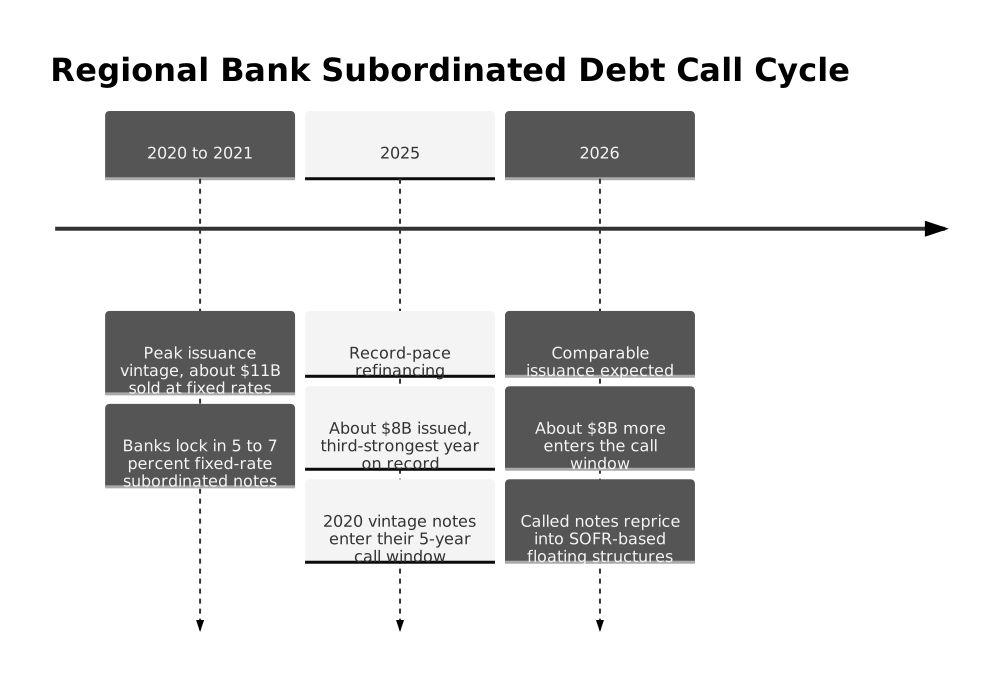
The call cycle driving 2025-2026 issuance. Original diagram built from Angel Oak Capital's 2026 bank debt outlook. 2020-2021 notes hit their 5-year call. Issuers are refinancing into costlier structures, not waiting for a reset.
Where That Cost Shows Up for Borrowers
A bank absorbing a higher cost of capital has three levers. Shrink lending, tighten underwriting, or reprice new credit. Most banks pull all three, at the margin, rather than picking one.
For a business line of credit, that usually shows up as more documentation first. Tighter covenant language and less flexibility on renewal come next.
The headline rate is the last thing to move. The paperwork moves first.
"Subordinated debt is long-term debt issued by bank holding companies. It ranks below other liabilities and qualifies as Tier 2 capital under FDIC and Federal Reserve guidelines."
Federal Reserve mandatory convertible debt and subordinated notes guidance
Quick Check
Don't wait for your bank's next capital raise to find out where you stand.
Meridian Private Line matches operators with bank, credit union, and non-bank tiers, by credit profile.
Check Capital Eligibility →What This Means Before Your Next Renewal
If your line of credit sits at a single regional bank, ask directly. Did that bank issue or refinance subordinated debt in 2025 or 2026? Most banks disclose it in quarterly filings.
A bank rebuilding its Tier 2 cushion isn't necessarily a bad partner. But it's more likely to tighten at renewal than expand your limit without a fight. Compare that posture against credit union LOC terms, which often move slower.
Haven't opened a facility yet? That's the case for a revolving line over a fixed term loan right now. A term loan locks in today's underwriting standard for years.
A revolving line lets you requalify every cycle instead.
Frequently Asked Questions
What is subordinated debt, and why do banks issue it?
Subordinated debt is long-term debt that ranks below deposits and senior debt in a bankruptcy. It absorbs losses before depositors do. That's why regulators let it count as Tier 2 capital, strengthening a bank's cushion.
Why is regional bank subordinated debt issuance a record this year?
2025 was the third-strongest year on record. Near $8 billion got issued. The 2020 peak-issuance vintage, about $11 billion, entered its 5-year call window.
Roughly $8 billion more enters that window in 2026.
Does a bank raising subordinated debt affect my line of credit application?
Not directly, but it's a signal. Banks build cushions when they expect to absorb loan losses. That usually travels with tighter underwriting on new commercial credit, business lines of credit included.